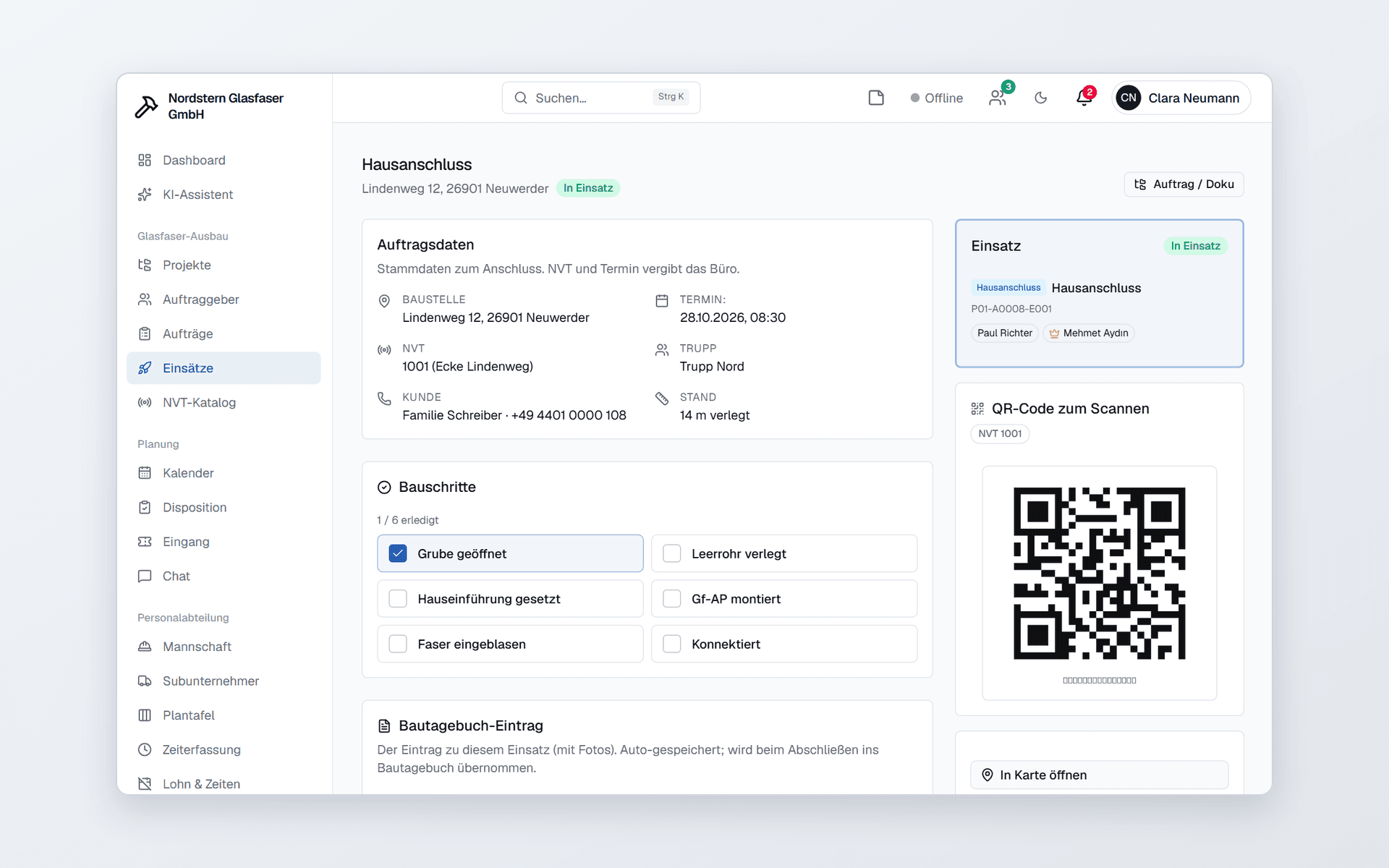
Trassenwerk is the operations platform of a fiber-optic build-out firm. It follows every house connection from the incoming order to the connected household: the office groups orders into build areas and dispatches crews and subcontractors, the foreman documents each step on site — build steps, photos, metres laid, the network operator's NVT QR codes — and the crew's hours run on the same phone. Developed in close collaboration with a German fiber-optic contractor, it has been in daily use there since August 2026.
What it solves.
Fiber build-out is logistics disguised as construction. Every build area means a long list of house connections, each passing through several trades — civil works, blowing the fiber, splicing — with in-house crews and subcontractors on the same streets, and a network operator that expects every connection documented in its own format. In most small firms that runs on WhatsApp groups, Excel and paper daily reports: the office never quite knows which crew is where, documentation gaps surface weeks later, and payroll gets rebuilt by hand from timesheets.
How it's solved.
- 01
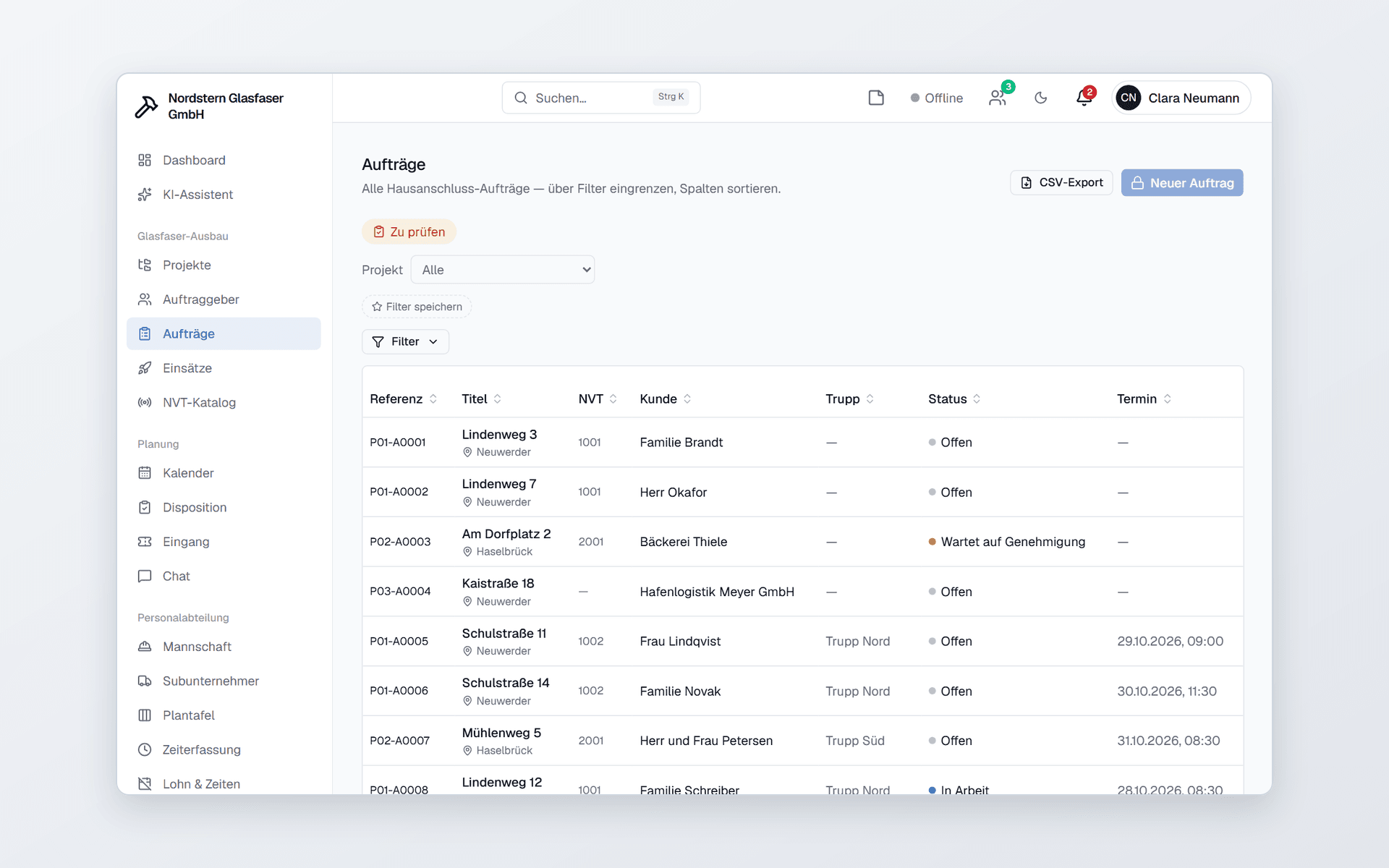
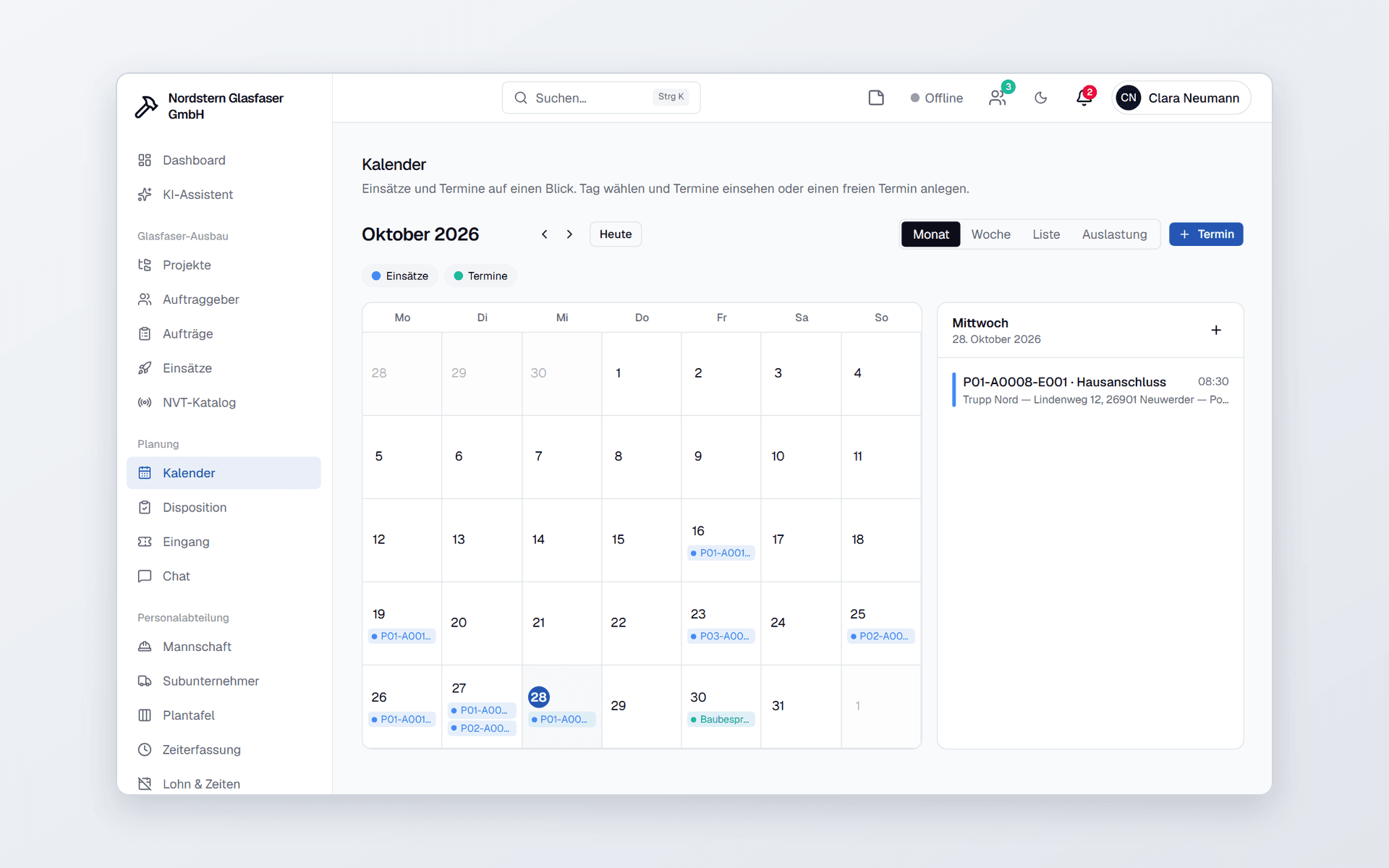
Dispatch: build areas (Projekte) group the house-connection orders (Aufträge); the office sends crews and subcontractors out as Einsätze from a dispatch board, a calendar with a workload view, and a planning board that shows who is clocked in and where.
- 02
Two independent status axes per order — progress and dispatch lane — so editing an address never moves a card, and the lane is derived in exactly one place.
- 03
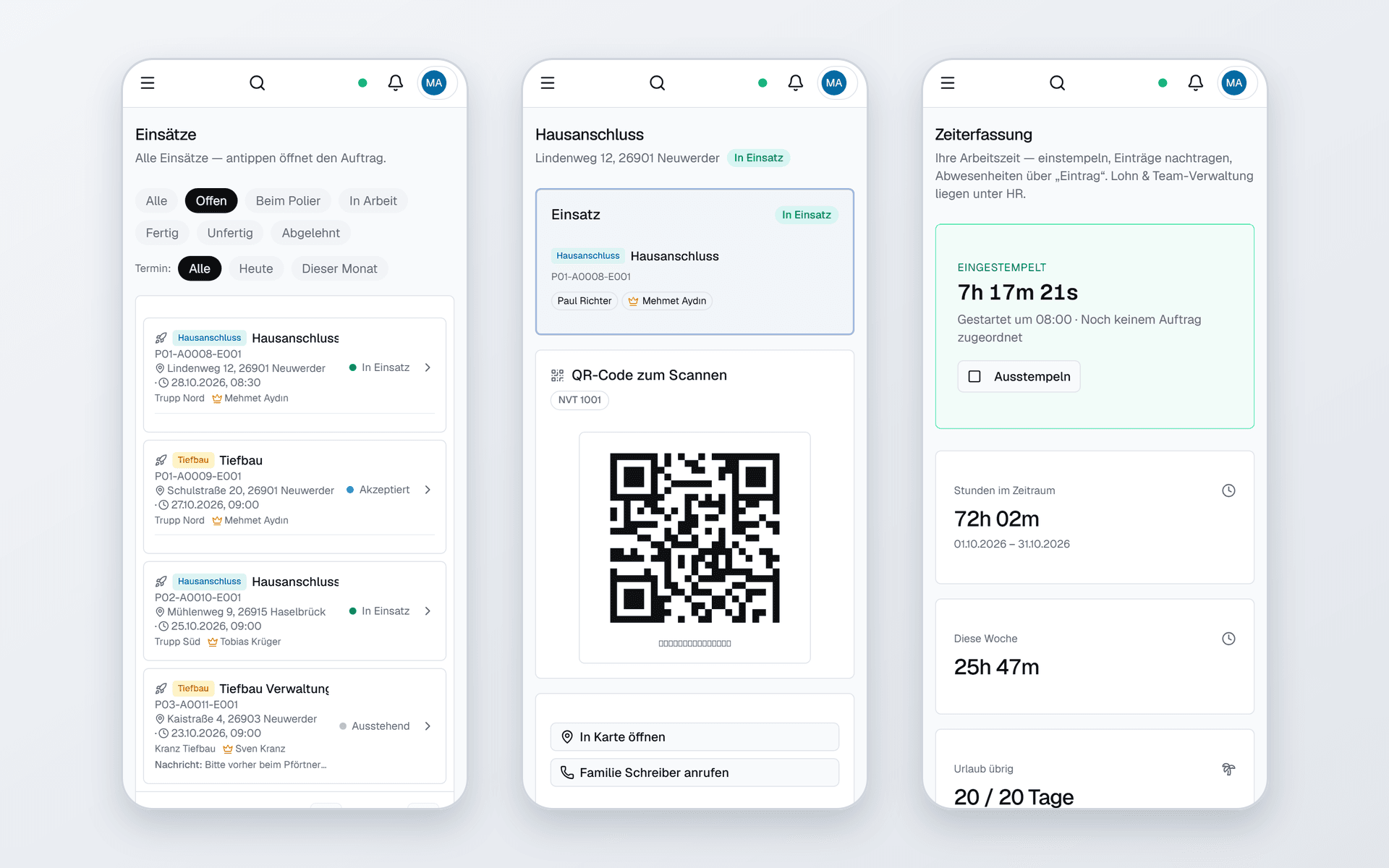
Field documentation on the phone: a build-step checklist, the daily site report (Bautagebuch) with photos, metres and depth, and the network operator's NVT QR codes — plus a handover PDF and exactly the fields the operator's export expects.
- 04
Time & payroll: clock in and out against orders, absences and vacation on a working-day basis, Sunday and holiday premiums by actual overlap (§3b EStG), guards against overlapping or implausible entries, and a DATEV payroll export.
- 05
Roles that match the company: owner, office, foreman, fitter and subcontractor logins plus owner-defined custom roles built from 30+ permissions — nobody can grant more than they hold. Households need no login; they get a private appointment link.
- 06
Communication: live team chat, a ticket inbox where one person claims each ticket, per-category web push, an iCal feed — and field screens in seven languages (DE, EN, PL, RO, RU, TR, UK) for mixed crews.
- 07
An in-app AI assistant (Claude) that answers questions and acts through the same service layer — and the same permission checks — as the UI; every destructive action waits for the user's approval.
- 08
Privacy by default: PII-scrubbed error tracking pinned to the EU, anonymised IPs in the audit log, TOTP 2FA encrypted at rest, per-document storage permissions, and records with a legal retention period anonymised instead of deleted.
What makes it interesting.
In daily production use
Built in close collaboration with a German fiber-optic contractor: since August 2026 its office, foremen, fitters and subcontractors run their working day on it. Requirements come out of weekly reviews with the customer; requests and bug reports arrive through the app's own ticket inbox and ship as reviewed pull requests.
Built for live customer data
A push reaches the live installation within minutes, so the process has to carry that: strict action → service → repository layering, 1,700+ automated tests (Vitest + Playwright), a typecheck/lint/dead-code gate plus an independent AI code review on every pull request, and expand/contract migrations.
A demo that cannot drift
The public demo runs the real application on an invented company held in memory — a Prisma-compatible engine whose relations and defaults are generated from the schema, writable per visitor, with no database behind it. When the schema changes, the test gate goes red until the demo follows.
Tech.
- Frontend
- Next.js 16React 19TypeScriptTailwind v4shadcn/uinext-intlPWA
- Backend / DB
- Server ActionsPrisma 7PostgreSQLAction → Service → Repository
- Auth & security
- Auth.js v5TOTP 2FACustom rolesSentry (EU, PII-scrubbed)
- AI
- Anthropic ClaudeTool useHuman-in-the-loop
- Integrations
- Supabase RealtimeWeb PushResendS3 object storageDATEV exportiCal
- Quality & ops
- VitestPlaywrightGitHub ActionsknipVercel